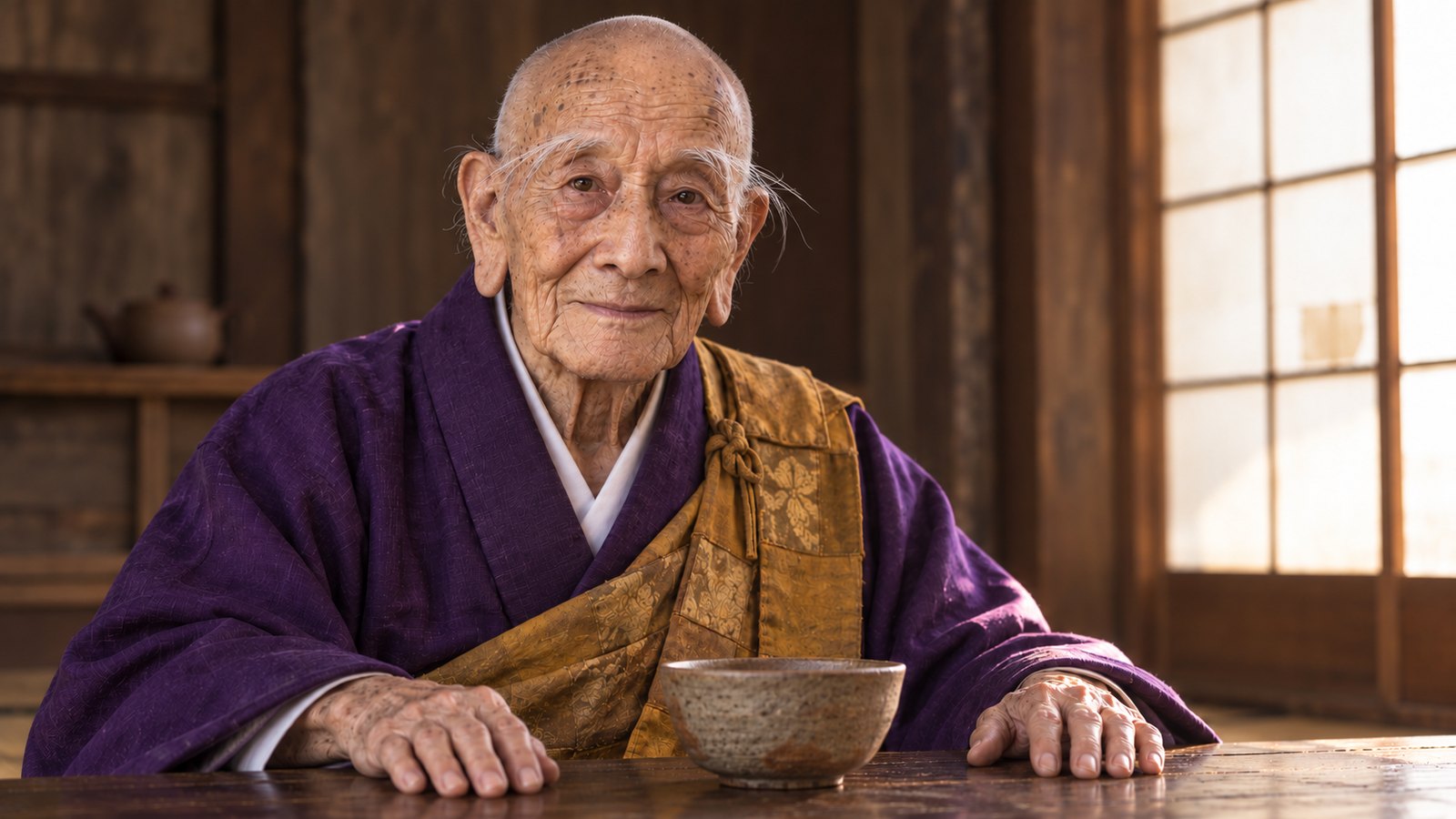
Master Jōzan111 years old · Zen monk

You are not tired. You are carrying.

111 Things to Stop Carrying is his book about guilt, worry, loss, and the people who hurt you: one hundred and eleven short things, two pages each. Open where it hurts. Put one down tonight.

Launch price $49 $29 · one payment

Send me the book — $29Instant download · Read it tonight · 7-day refund

Phone, tablet or computer·One payment, no subscription·7-day money back

111 Things to Stop Carrying — the book

Instant digital book · $49 $29 today · 7-day money-back guarantee

The launch price ends in

0days
00hours
00min
00sec

Then the book goes to $49 and stays there.

Read one of the 111 first. It is free. ↓

You know the weight

Some of it was thrown at you. Some you picked up yourself.

You wake at three in the morning and run the same conversation. You still set a place, in your mind, for someone who is not coming. You say you are fine so often that you have started to believe the word. Everyone calls you the strong one, and nobody checks on the strong one.

A man who has lived one hundred and eleven years has one word for all of it. Stones. A few are pinned on you like medals, and those are the heaviest. Every one of them can be set down. Not forgotten. Not forgiven on command. Set down. He will show you how, one stone at a time.

You judge the person you were with everything you learned afterward.

Thing 1

Somebody called you the rock. You have been drowning quietly ever since.

Thing 96

You have waited so long you have forgotten that waiting is a choice.

Thing 37

They told you it would pass. It did not pass. It moved in.

Thing 69

You call it kindness. Look closer.

Thing 45

You have apologized for your own chair.

Thing 102

You lie awake fixing things that are not in your house.

Thing 20

You hold the people you love as if they were already leaving.

Thing 64

Eight of the one hundred and eleven. Each one is two pages long.

Read one now

Here is one of the hundred and eleven. Whole.

Not a teaser. The two pages exactly as they are in the book. If it is about you, you will know by the second paragraph.

Thing 96 of 111 · Part 7 · The Heavy Virtues

96

Being strong for everyone

Somebody called you the rock. You have been drowning quietly ever since.

Hasegawa-san, the eldest of five, came up the steps from Okayama in a wet October with her shoes full of rain. She had arranged both her parents’ funerals and signed every paper for her brothers and sat with a sister through a divorce, and the family called her, with love, the rock. At my table she held the cup in both hands and did not drink. I did not ask her anything. Goma climbed into her lap, uninvited, and turned twice and settled, and Hasegawa-san began to cry, and apologized, and went on crying. “I have not done this in front of anyone in years.” The cat did not mind. The tea went cold. Nobody in the room needed her to be anything.

Someone decided you were strong, probably when you were young, and you have been paying for the compliment ever since. The strong one is the one nobody checks on. The strong one gets the phone call at midnight and never makes one. You have arranged your life so that there is no chair in it for you to fall into, and you call this being dependable, and it is, and it is also a kind of hiding. My teacher wept at funerals, in front of the whole village, and dried his face on his sleeve. Strength that cannot be seen bending is a wall waiting for the one wind it has not met. Let someone see you bend. Let one person, once, be strong for you, and notice that the house does not fall.

· · ·

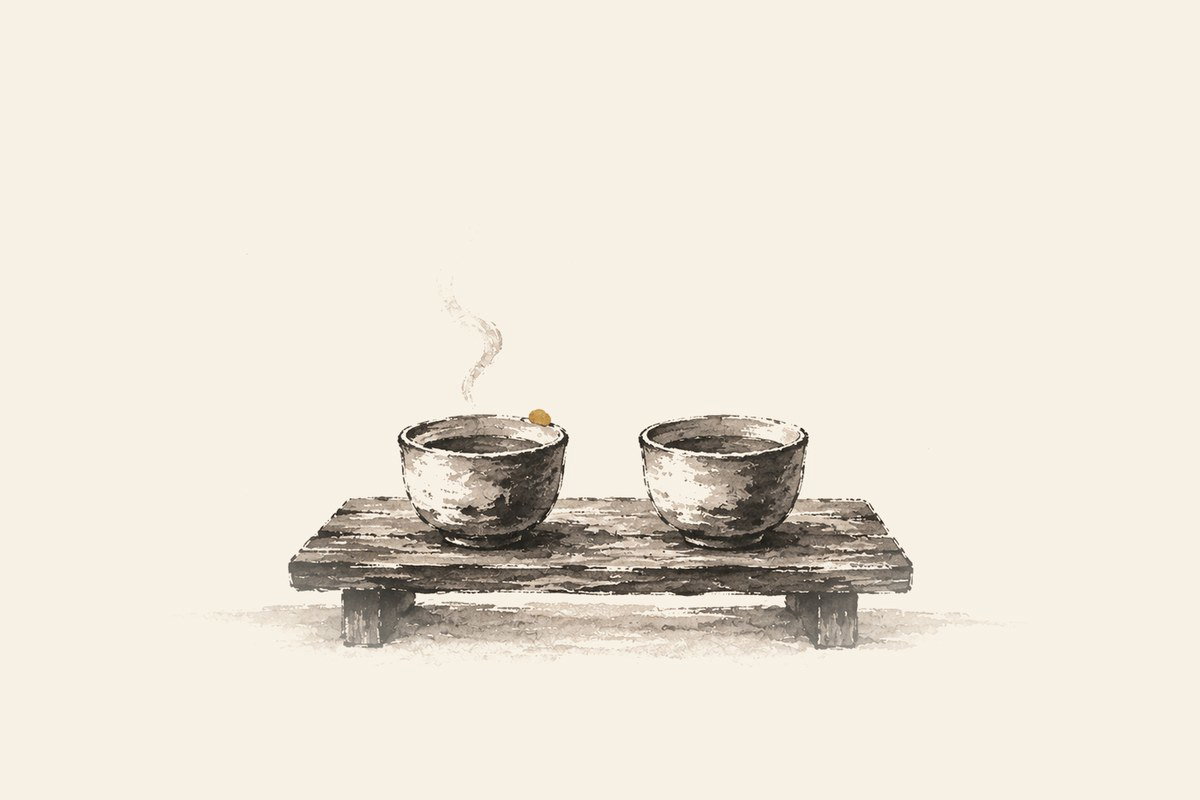
The rock in the river is the one the water works hardest.
Read another one: Thing 65, for someone who has lost someone

Thing 65 of 111 · Part 5 · Loss

65

The ones who died before you

You have outlived people who were supposed to bury you.

Tetsuo came to this mountain at eighteen and died here at sixty, in the spring, of an illness that took a year to do its work. I was eighty-seven. I had assumed, in the way one assumes a wall will be there, that he would wash my body and ring the bell for me. Instead I washed his. I had done this for my teacher and for my mother, and I knew the motions, and my hands did them, and the whole time a voice in me kept saying: this is the wrong order. We burned incense. Hōjun, who was twenty-three, rang the bell. I stood in the courtyard that Tetsuo had swept for forty years and I did not know what to do with my hands, so I picked up his broom.

There is an order we believe in, so deeply that we never say it aloud: the old go first. When the order breaks, the grief has a second wound inside it, which is the wrongness, and the wrongness has no cure, because the order was never a promise. It was only a hope we had mistaken for a law. I will not tell you it makes sense. It does not. What I can tell you is what the broom taught me that spring. The one who is left is left with the work. Not as punishment — as the only remaining way to be near them. I swept Tetsuo’s courtyard every morning for a year. It was the longest conversation we ever had.

· · ·

The broom was his. The courtyard, that morning, was mine.

If that was about you, there are a hundred and ten more, and at least one of them is yours. If it was not, the index at the back will find the one that is.

Send me the book — $29Instant download · 7-day refund
Master Jōzan at his low table

The man at the table

“I am a hundred and eleven years old. I have buried nearly everyone I started with.”

I was born in a charcoal-maker’s house in the hills north of Kyoto. At fifteen I went to Osaka to work for a cloth merchant and tried being rich first. At nineteen I walked up a mountain to a small temple and did not explain it well. I have been a monk for most of a century and the abbot of that temple for forty-three years, and for the last seventy of them people have climbed the steps to sit at my table and tell me what they carry.

I did not invent anything in this book. My teacher gave most of it to me, and I have only carried it long enough to know which parts are true. Mari, who lives here, wrote down what I said over one winter. If a sentence is beautiful, it is hers. If it is blunt, it is mine.

What comes up the steps

In seventy years at this table I have heard perhaps a dozen stones, carried by thousands of hands. A thing said in anger that cannot be unsaid. A parent who could not love. A death that will not finish. A marriage that ended. A marriage that did not. Children who call less than the heart hoped. A mistake with money the whole family paid for. A body that is not what it was. And the heaviest, carried proudly: being the one who holds everything together. Whatever yours is, it is in this book, because it has been at this table.

I am not going to tell you it gets lighter. I am going to tell you how it is carried, and then how it is set down. Warm your hands on the cup.

JōzanQuiet Mountain

Open where it hurts

This is not a book you read in order.

At the back of the book there is a page called If you cannot sleep tonight. You find the sentence closest to what you carry, and it tells you which three things to read. One is enough. Then you sleep. The rest will keep.

I lost someone, and it will not finish65 · 69 · 80
I keep replaying a conversation or an argument18 · 70 · 42
I did something I cannot forgive myself for1 · 4 · 15
Someone hurt me and never said sorry37 · 45 · 9
I am worried about something that has not happened17 · 31 · 20
I feel I have wasted my life, or part of it7 · 3 · 25
I am angry at my family13 · 14 · 39
The person I love is not who they were52 · 51 · 68
Someone left me49 · 50 · 54
I am so tired, and no one sees it105 · 96 · 89
I am alone, or afraid of being alone54 · 55 · 60
I am caring for someone who is slipping away47 · 68 · 64
I am angry, and it will not go down4 · 42 · 48
My children call less than I hoped53 · 61 · 58
I cannot stop thinking at three in the morning27 · 32 · 10
I say yes when I mean no41 · 107 · 36
I am afraid of getting old, or of dying74 · 67 · 76
I am ashamed of something that happened to me16 · 12 · 11
I feel I am not enough, or too much90 · 102 · 21
I made a mistake with money5 · 86 · 106
I am always the one who holds everything together96 · 101 · 40
I never got to say it70 · 2 · 59
I have everything and I still feel heavy85 · 86 · 110
I do not know what is wrong, only that something is23 · 82 · 32

Twenty-four doors into the same book. The numbers are things, not pages. Thing 65 is two pages long.

Look inside

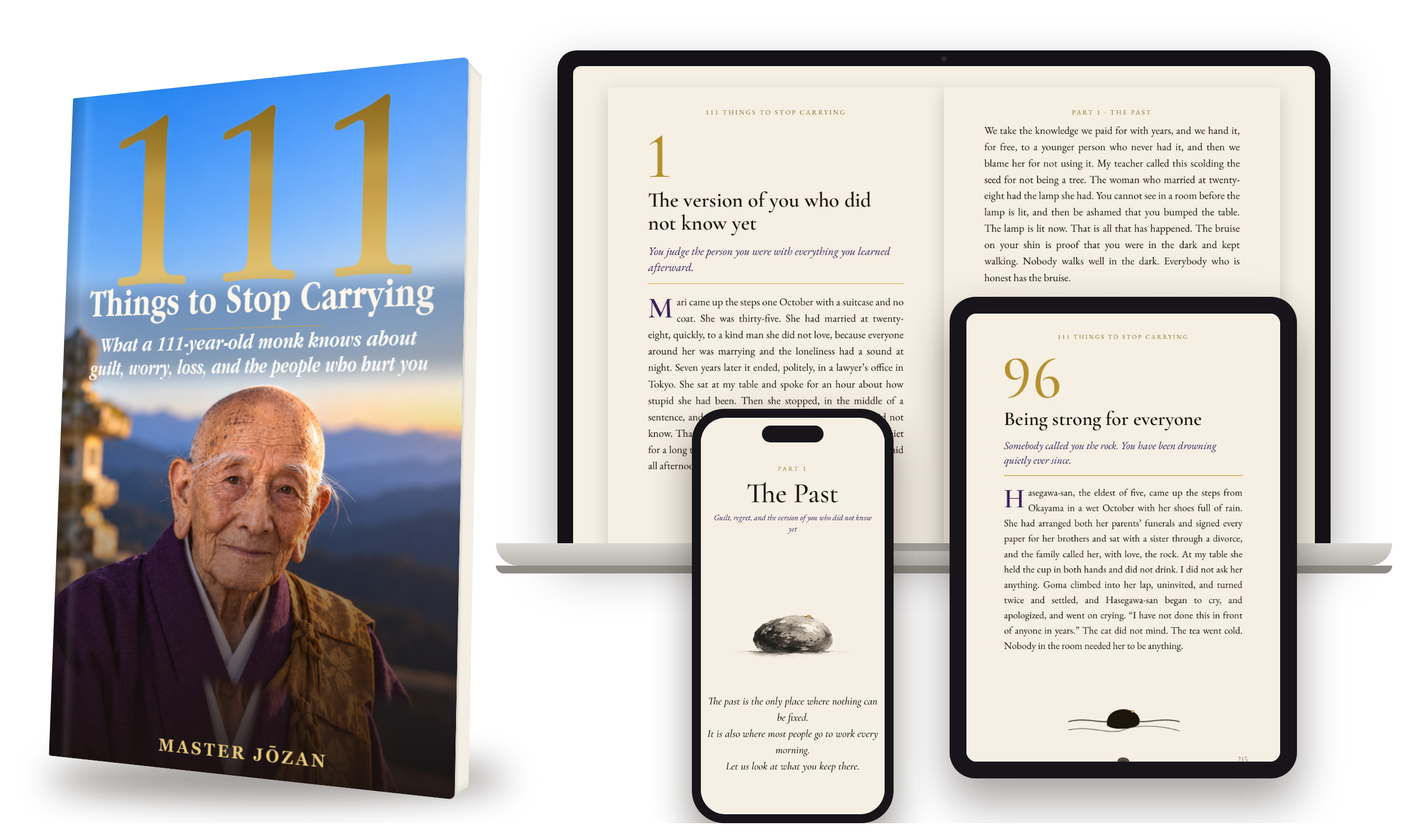
Two hundred and fifty-nine pages, set like a book you would keep.

Every one of the 111 things has its own ink drawing. Seven parts, each opened by an original sumi-e painting. Six full-page diagrams for the ideas that are easier to see than to read. Large, quiet type, on paper the color of an old letter, that reads the same on a phone at three in the morning.

If you have met him in a one-minute video, this is the rest of the conversation.

Tap a page to read it.

The book on a laptop, a tablet and a phone

Reads the same on a phone at three in the morning, on a tablet in bed, or printed and kept by the kettle.

Page from the book

Tonight

One stone, before you sleep.

Minute one

You pay once and the book opens on your phone. A copy goes to your email as well, in case you ever lose it.

Minute two

You turn to the last page, If you cannot sleep tonight, and find the sentence closest to what you carry.

Minute six

You have read one thing. Two pages, about four minutes.

Minute seven

You do the one small thing it asks. A stone in your pocket. A kettle on. A sentence said once, out loud, to nobody.

Then you sleep. The other hundred and ten will keep.

Before you buy

Is this for you?

This book is for you if…

  • You have carried the same thing for years and are tired of being told to “just let it go.”
  • You are between forty and ninety, and more of your life is behind you than you expected.
  • You want something to read at night that is quiet, plain, and true. Not a program. Not a workbook.
  • You have never read a word of Buddhism and do not intend to start. Nothing here asks you to believe anything.
  • You are buying it for someone else: a sister, a father, the friend who is always the strong one.

It is not for you if…

  • You want a quick fix, a hack, or a seven-day transformation. He is 111. He does not hurry.
  • You want affirmations. He will tell you the truth, kindly, and then pour the tea.
  • You want someone else to carry it for you. He will only show you how to set it down.
  • You are in crisis. A book is not a doctor; please go to a person first.

The book

111 Things to Stop Carrying

The complete book, as a PDF you keep.

111 Things to Stop Carrying

Yours tonight, on whatever you are reading this on.

The complete digital book

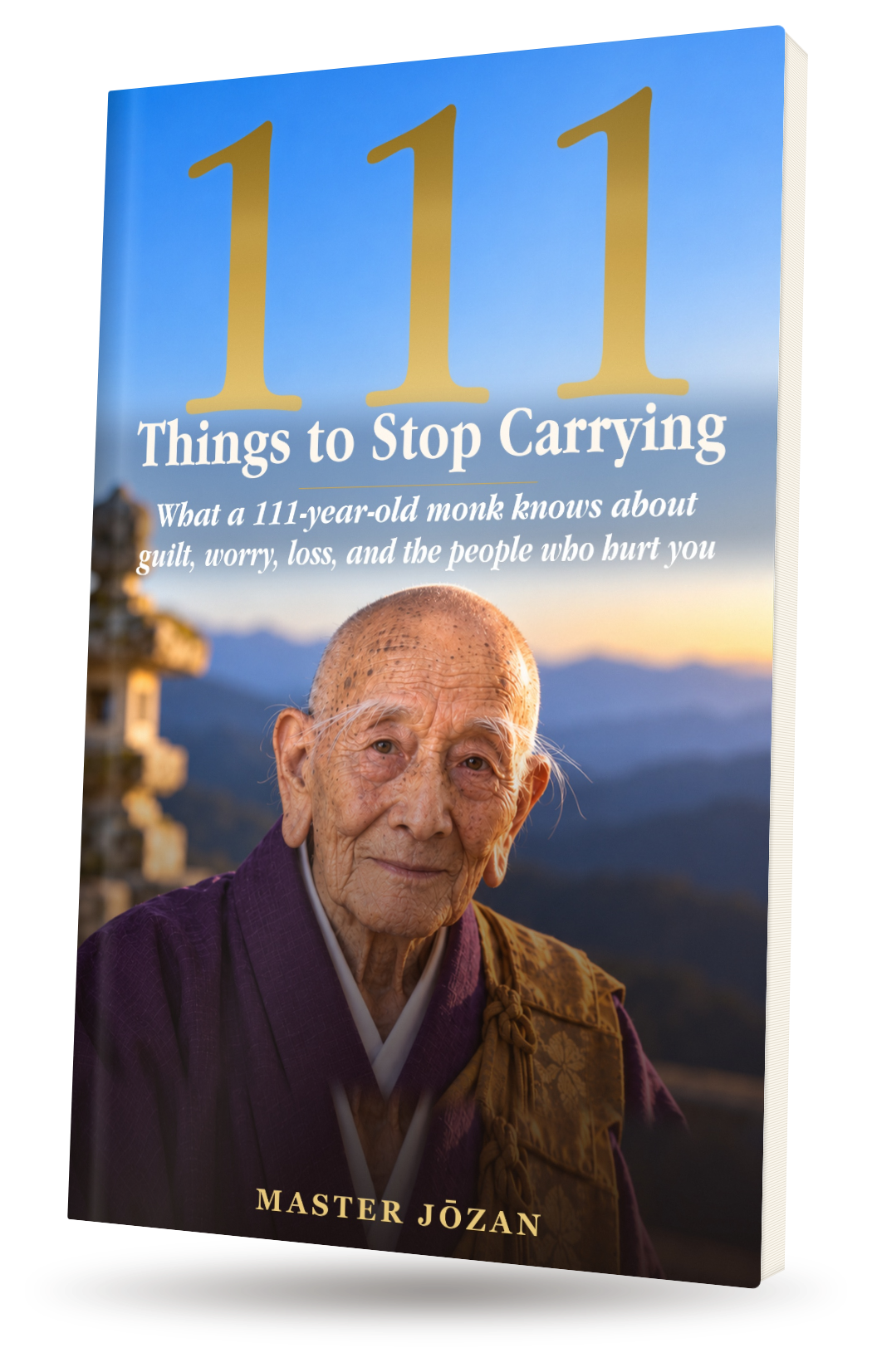
What a 111-year-old monk knows about guilt, worry, loss, and the people who hurt you

259 pages · 6 × 9 in · reads on any phone, tablet or computer

  • 111 things to stop carrying, in seven parts: the past, the mind, other people, love, loss, the self, and the heavy virtues, the stones people carry proudly.
  • 111 stories from the low table: visitors, students, a teacher, a brother lost at sea, a cat named Goma.
  • The twelve practices: the Stone Walk, the Kettle, the One-Night Rule, the Closed Door and eight more. Each needs nothing you do not already have in your house.
  • “If you cannot sleep tonight”, the index that tells you where to open the book by what hurts.
  • Six full-page diagrams, 111 ink drawings and seven original sumi-e paintings.
  • Clickable contents and bookmarks, and a copy sent to your email so the book is never lost.

$49 $29 · one payment

Send me the book — $29Instant download · 7-day refund

This is the launch price, for the first readers. When they have it, the book goes to $49 and stays there.

It costs what a hardcover costs, and less than one hour with anyone whose job is to listen. For that you get seventy years at his table, two pages at a time, for as long as you need them.

If you are reading this page thinking of someone else, buy it and send her the file with one line: “Thing 96 is about you.” She will know what you mean.

The seven-day promise

Read for a week. Open where it hurts. Do one small thing. If the book is not for you, write to us within seven days and every dollar comes back. No questions, no hard feelings. Keep the pages you read.

Before you ask

Questions people ask at the table

Is this a physical book?
No. It is a PDF — 259 pages, 6 × 9 inches, the same size as a paperback — that opens on any phone, tablet or computer, with clickable contents and bookmarks. You can print it, all of it or the one thing you want to keep by the bed. There is no printed edition yet.
Is it the same as the videos?
No. The videos are one minute each. The book is the rest of the conversation: a hundred and eleven things, each with its story, its teaching and one small thing to do, plus the twelve practices and the index. Nothing in the videos is the book. The book is the book.
I am not good with technology. Will I be able to open it?
If you can open an email, you can open this book. It arrives as a link and as a file, and it opens with a tap on any phone, tablet or computer. If it does not, write to us and a person will send it another way.
Can I read it on a Kindle?
Yes. Amazon’s Send to Kindle accepts PDF files. It also reads well on an iPad, on a phone, or printed and kept by the bed.
I am not religious. Is this going to try to convert me?
No. The teachings come from Zen, but nothing in the book asks you to believe anything, chant anything, or sit on a cushion. The twelve practices need a kettle, a broom, a stone and some patience. Master Jōzan says it plainly: “Do not believe me. Walk it.”
I do not have time to read.
Each thing is two pages, about four minutes. The book is built to be opened, not finished: one thing a night, where it hurts. It was never meant to be read in order.
My loss is recent. Is it too soon?
Part 5, Loss, was written for exactly that week and the years after it. It will not tell you it gets lighter. It will tell you how it is carried. If what you are carrying is heavier than a book can hold — if there are days you do not want to be here — please go to a person first: a doctor, a friend who will come tonight, or the crisis line in your country. The book says this too, in his own words.
Is it for men or for women?
For people. The visitors who climb his steps are widows and salarymen, grandmothers and stationmasters, a nurse, a carpenter, a postman. The stones are the same.
What if it is not for me?
Write to us within seven days and you are refunded in full. No questions.
What if I lose the file?
Write to us and we send it again, for as long as the book exists.
Master Jōzan on the mountain at dawn

Before you go

Tonight, something you have carried for years can stay on the table.

You will still remember it. You will still know its weight. You will simply not be holding it when you fall asleep.

$49 $29 · one payment

Send me the book — $29Instant download · Read it tonight · 7-day refund

P.S. The first thing in the book is called The version of you who did not know yet. It is about the person you were before you learned what you know now, and the way you keep sentencing them with evidence they never had. If you have ever lain awake doing that, start there. It is two pages.

P.P.S. He asks one thing of every reader at the end: when you have finished, make tea for another person. Not as a practice. Because that is what the hands are for, once they are empty.